Space critical equipment for EU non-dependence HORIZON-CL4-2027-SPACE-07-84

Scaling and deploying innovations in migration management HORIZON-CL2-2027-01-TRANSFO-08
October 19, 2026
Integrated Infrastructure Retrofit Approaches with Innovative Energy Storage Technologies HORIZON-CL5-2027-07-D3-27
October 19, 2026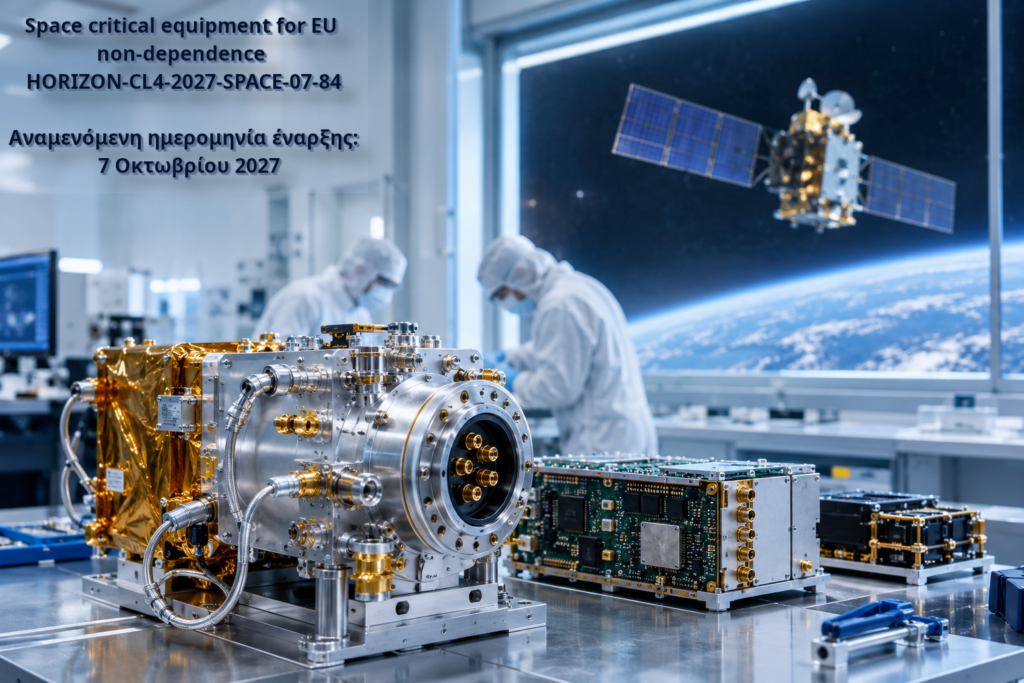
Ελάτε σε επικοινωνία με τον προσωπικό σας σύμβουλο της ILF consulting, click ΕΔΩ.
Ακολουθήστε μας στα Social Media
Αποτελέσματα και επιτυχίες υποβολών περιόδου 2025, ILF consulting
Για νέα και έγκυρη ενημέρωση κάντε κλικ ΕΔΩ
Ενεργά Προγράμματα Επιδοτήσεων < Ανοιχτά προγράμματα επιδοτήσεων για Υποβολές >
Εδώ, Δίνουμε Λύση
Ενοικίαση Γραφείων / Φορολογικές Έδρες / Υπηρεσίες Θερμοκοιτίδας / Αίθουσες Εκθέσεων – Σεμιναρίων – Meeting rooms Φορολογικές Έδρες (Virtual office) από 29,00 € Για περισσότερες πληροφορίες ελάτε σε επικοινωνία με το αρμόδιο τμήμα μας
Η ILF consulting αρωγός πάντα στις υπηρεσίες των Δήμων, Δημοσίων Φορέων, Επιχειρήσεων, ΚΟΙΝΣΕΠ και Ιδιωτών για την διευκόλυνση και ορθολογιστικότερη εξυπηρέτηση τους, προσφέρει την εμπειρία της και αναλαμβάνει την δημιουργία φακέλου και όλη την σχετική διαδικασία, για την υποβολή προτάσεως χρηματοδότησης -επιδότησης
H ILF consulting ΔΕΝ έχει εξωτερικούς συνεργάτες πάρα μόνο στελέχη και τμήματα που απαρτίζουν το δυναμικό της .
Δυνατότητα ενημέρωσης – Εκτέλεσης υπηρεσιών και Συναντήσεων – Πανελλαδική κάλυψη και εκτός Ελλάδος.
Άμεσα ο Νέος Αναπτυξιακός νόμος. Προετοιμασία υποβολής στον αναπτυξιακό νόμο.
Κάντε εγγραφή στο newsletter μας για να ενημερώνεστε άμεσα & πρώτοι για τα νέα προγράμματα επιδοτήσεων και την έναρξη υποβολών τους.
Θέλω να ενημερώνομαι για να προλάβω
Expected result:
The project results are expected to contribute to all of the following expected outcomes:
- Strengthening the EU’s strategic autonomy by reducing non-EU dependencies on critical space equipment and related technologies throughout their supply chain;
- Providing unrestricted access to critical space equipment and associated technologies relevant to EU space missions;
- Developing or regaining the capability to operate independently in space by developing resilient supply chains of critical space equipment and related technologies, based on EU supply chains and/or reliable and trustworthy supply chains not affected by export restrictions outside the EU;
- Strengthening competitiveness by developing products and capabilities that achieve an equivalent or higher level of performance than those originating from non-EU countries and compete globally;
- Creating new opportunities for manufacturers by reducing dependence on export-restricted technologies outside the EU.
Scope:
Unrestricted access to state-of-the-art space equipment and related technologies is a prerequisite for the EU space industry to respond to EU space missions. However, in particular for some equipment families, the solutions available in the EU do not meet current high-performance space requirements and alternative products, originating from non-EU countries, are either affected by export controls outside the EU with additional territorial application, which limit access, re-export or raise challenges for reliable supply chains for the implementation of EU space missions with a security dimension.
Under this theme it is expected to finance and implement development projects aimed at maturing critical space equipment with the ultimate aim of reducing dependency on non-EU countries, establishing a long-term sustainable supply chain and supporting the EU’s strategic autonomy in space. The choice of supply chains reflects this objective. Therefore, the supply chain should preferably be fully EU-based and, where this can only be achieved partially (i.e. due to a lack of existing EU capabilities that cannot be deployed within the project), services provided by non-EU countries shall nevertheless ensure that the overall supply chain remains reliable and is not affected by export controls outside the EU. The latter scenario is subject to the approval of the granting authority.
The list of space equipment and associated technologies related to this topic will be selected based on needs related to strategic institutional programmes, contributions from relevant European stakeholders and the EU Observatory on Critical Technologies. It will be proposed in 2026 and validated by the higher education delegations.
Space is a low-volume market influenced by a dynamic industrial landscape compared to the terrestrial market and therefore technological push and/or bilateral collaborations should be strengthened between European non-space and space industries. Furthermore, the proposed activities should be complementary to national activities and European space agencies. Complementary activities should be clearly identified, described and the proposal should indicate how complementarity is ensured.
Technology readiness level – Expected technology readiness level from completed projects
The activities are expected to achieve TRL 6 by the end of the project – see general annex B.
Today, EU citizens enjoy satellite television viewing, increasingly accurate global navigation services for all transport modes and users, extensive Earth monitoring for land, sea, atmosphere and climate change, global meteorological observation and precise mapping of a large number of variables. Space also makes a significant contribution to security crisis management and emergency services. The components of the EU space programme (such as EGNSS and Copernicus) are key assets of EU policies on climate, environment, transport, agriculture and a secure society. Finally, the space sector is a source of economic growth and employment.
This destination is structured along the following structural elements:
- access to space, i.e. the ability to transport satellites, cargo and people into space; to manufacture and put into service the required vehicles, including reusable systems; and the operation of related facilities and services.
- Use of space on Earth, i.e. the ability to provide space services and applications for secure communication, navigation and Earth observation, including through the EU space flagship initiatives Galileo, Copernicus and IRIS 2.
- Space surveillance, i.e. the ability to detect, track and predict the trajectory of spacecraft, near-Earth objects and space debris throughout their lifetime; to exchange data with relevant stakeholders; and to provide solutions for the safe management of international space traffic. It also includes the monitoring and prediction of other impacts on the space environment, such as space weather phenomena.
- Operating in space, i.e. the ability to inspect, rendezvous and disembark, capture, repair, refuel, refit, manufacture, assemble and disassemble, reuse/recycle, relocate, remove and transport operational, non-operational and other objects in space, including platforms or larger structures.
- Exploring Space, i.e. the ability to conduct high-profile space exploration activities, perform excellent science and utilize space data to increase our knowledge of the Universe and celestial bodies, with the aim of exploring them for scientific and socio-economic benefits.
- Strengthening space, i.e. the ability to sustain the above strategic capabilities by promoting the competitiveness of the EU space sector; improving education and developing the required skills; accelerating the pace of innovation; supporting the EU’s non-dependence on critical technologies; and strengthening international cooperation.
These building blocks are implemented through the following sectors:
- Area 1: Access to space
Autonomous access to space is a prerequisite for the EU’s strategic autonomy. It is a key enabler and an indispensable element of the space ecosystem and value chain. European launch systems enable the autonomous deployment of satellites for the Union’s flagship initiatives Copernicus, Galileo/EGNOS and IRIS 2 and contribute to the security and resilience of Europe’s core space infrastructure.
In a context of profound changes in the competition and launch services paradigm, it is crucial to ensure that Europe improves the resilience and cost-effectiveness of its autonomous access to space. This requires urgent activities to enable and further consolidate operational capabilities before 2030 in line with the Strategic Research and Innovation Agenda for EU-funded space research supporting competitiveness, adopted in 2020.
This challenge will be addressed by promoting space transport solutions by supporting building blocks for smart technologies and digital solutions and by facilitating access to European spaceports.
- Sector 2: Acting in Space
Space Operations and Services (ISOS) will ensure the EU’s freedom of action in space and increase the resilience, sustainability, safety and security of its space infrastructure, while contributing to strengthening the competitiveness of its space sector. R&I activities should put Europe at the forefront of emerging service applications, including inspection, rendezvous and docking, capture, repair, reconfiguration, assembly and disassembly, manufacturing, resource extraction, reuse/recycling, removal and transport of objects in space, for satellites, platforms and larger structures. The core space R&D activities will be driven by a pilot mission that will help create and promote a new space economy.
Game-changing innovations and enabling technologies are at the heart of ISOS and are an important focus of future actions. The paradigm shift towards adaptive space systems is based on automation and robotics, artificial intelligence, modular and reconfigurable spacecraft concepts. Together with other enabling technologies such as electric propulsion, intelligent mechanisms and interfaces or advanced GNC, they will provide new ways of how space resources are designed, produced, tested, transported and operated. Different tools implemented with AppStore-like approaches will benefit the future space ecosystem and promote a circular economy.
- Area 3: Use of space on Earth in relation to telecommunications
The EU Secure Connectivity Programme aims to develop a secure and autonomous space connectivity system to provide guaranteed and resilient satellite communications to Earth. The objectives include the development, construction and operation of a state-of-the-art multi-orbital space connectivity system, continuously adapted to the evolving demand for government satellite communications; complementing the EU pool of satellite communications capabilities and services; and integrating the GOVSATCOM ground segment infrastructure, as well as the European Quantum Communications Infrastructure (EuroQCI).
Within the framework of the European Partnership for Globally Competitive Space Systems (Partnership for Space), I will focus on coherent activities in the field of digital developments under the broad heading “Digitalization for commercial space solutions”, and more specifically on collaborative and collaborative solutions for Earth observation and satellite telecommunications missions.
- Area 4: Use of space on Earth related to Earth observation
The development of Copernicus core services (climate change, marine monitoring, land monitoring, atmosphere monitoring, emergency management and security) is carried out through projects launched under previous R&D work programmes.
Within the framework of the European Partnership for Globally Competitive Space Systems (Partnership for Space), I will focus on coherent activities in the field of digital developments under the broad heading “Digitalization for commercial space solutions”, and more specifically on collaborative and collaborative solutions for Earth observation and satellite telecommunications missions.
In addition, we will also try to support the development of innovative applications of Copernicus services and data. That said, this support also comes from activities outside higher education carried out by EUSPA, the EU agency for the space programme: cooperation with receiver manufacturers, with mobile phone manufacturers, with car manufacturers, etc., as well as through influencing the development of policies where the use of Earth observation data is required.
- Area 5: Use of space on Earth in relation to satellite navigation
For Galileo/EGNOS, the international context, the competitive environment with emerging players, including from the private sector, innovative techniques in the value chain, such as the LEO level for PNT or the automation of ground segments based on artificial intelligence, the growing threats in space and cyberspace and the evolution of technologies, components and systems, require the continuous adaptation of the EU space infrastructure to these changing realities.
To address these challenges, the EU needs continued investment in R&D for innovative concepts, technology and mission systems. These measures will ensure the continuity of the EGNSS service, minimise the risks to the integration of the technology into the infrastructure, thanks to the expected development and testing, including in orbit, and better protect this infrastructure from modern threats (in particular cyber threats, jamming/spoofing, natural hazards).
These investments in R&D will help maintain the EU’s leadership in global satellite navigation systems and strengthen the EU’s strategic autonomy.
Furthermore, we will also try to support the development of innovative applications of EGNSS services and data. That said, this support also comes from activities outside higher education carried out by EUSPA, the EU agency for the space programme: cooperation with receiver manufacturers, with mobile phone manufacturers, with car manufacturers, etc., as well as through influencing the development of policies where the use of satellite navigation data is required.
- Sector 6: Space sciences and exploration
Space sciences and exploration are important areas to promote for several reasons, focusing on areas where the EU can add value with limited financial means. Firstly, it is crucial to capitalise on Europe’s investments in space missions and to exploit data originating from European space missions (including demonstration and validation). This should form the basis for future exploration missions. Furthermore, such a focus on sciences will strengthen the position of leading European scientists and will also promote societal interest in space. Last but not least, it will expand human knowledge and humanity’s natural curiosity.
- Sector 7: Site monitoring
Orbital space infrastructure, the data and services they provide have become essential for European societies and economies and for the daily lives of Europeans. However, due to the increasing congestion of orbital space, the likelihood of a satellite being seriously damaged or destroyed in a collision has increased dramatically. This risk requires action to preserve European interests by protecting its private and public investments in space in a sustainable way.
Based on the EU Space Programme, the capabilities of the Space Situational Awareness (SSA) and Space Surveillance and Tracking Services (SST) component are being developed and consolidated through a partnership of 15 Member States. The EU SST Partnership Agreement entered into force on 11 November 2022. With this partnership, EU SST builds on the good results achieved by the initial consortium of 5 Member States and aims to ensure continuity of activities and service provision, improve specialization of expertise and address the duality and security dimension of SST.
EU SST relies on European industry, including start-ups, to develop and improve national publicly owned capabilities based on the requirements of the partnership. In pursuit of the EU’s strategic autonomy, both in terms of the need to protect EU space infrastructure and in terms of the need to enhance EU SST capabilities, research and development activities aim to strengthen and consolidate EU SST autonomy in all orbital bands beyond the existing network of national assets, building on Member States’ contributions and leveraging complementary contributions from European private capabilities and commercial initiatives.
Importantly, the SSA also covers the areas of Space Weather (SW) and Near-Earth Objects (NEO). For these areas, activities are ongoing and no additional activities are required under the 2026-2027 working group.
- Area 8: Strengthening space through EU non-dependence on key critical space technologies
Ensuring non-dependence on critical space technologies is crucial, especially in the current geopolitical context. The European Commission has undertaken various activities and developed new tools (e.g. the EU Critical Technologies Observatory) to assess space technologies and identify those that are critical in terms of dependency. Under this area, a number of technological developments will be launched with a focus on priorities stemming from ongoing and planned EU space missions, including IRIS 2. Emphasis will be placed on reducing non-EU dependencies on critical space technologies throughout their supply chain, from advanced materials to components, equipment and subsystems; providing unrestricted access to advanced space technologies relevant to EU space missions and programme components; developing or regaining the capacity to operate independently in space by developing resilient space technology supply chains, building on EU supply chains and/or reliable and trustworthy supply chains not affected by export restrictions outside the EU; enhancing competitiveness by developing products and capabilities that achieve an equivalent or higher level of performance than those originating from countries outside the EU and compete globally; and creating new opportunities for manufacturers by reducing dependence on export-restricted technologies.
- Area 9: Stimulating space through innovative space technologies
Knowledge of quantum technologies is essential for the EU’s technological dominance and their use in EU space missions will provide significant improvements in the performance of EU space systems. Their developments will contribute to the EU taking a leading role in this field, in particular in quantum detection technology based on quantum accelerometers, which was developed in the context of the Pathfinder Quantum Space Gravimetry mission.
- Area 10: Enhancing space through IOD/IOV opportunities
IOD/IOV opportunities are still needed for experiments that require concentration, as well as for read-flight satellites. This includes the air ticket initiative to support the competitiveness and innovation of the European space sector.
- Area 11: Strengthening space through support for entrepreneurship
Business development, acceleration and scaling up of start-ups are also essential, which led to the creation of the CASSINI initiative for space entrepreneurship. CASSINI provides support to business and innovation-friendly ecosystems, including strengthening entrepreneurial skills in the space market segments and digital services based on space data. CASSINI also aims to make start-ups and scale-ups investment-ready and able to secure venture capital financing, as well as to leverage synergies with the InvestEU programme and the EU Space Programme.
- Area 12: Strengthening space by supporting the Space Act and cybersecurity
Interinstitutional discussions on the adoption of an EU space instrument will start once the Commission adopts its proposal in 2025. Once adopted, it will be important to foresee a number of studies and similar activities to support its implementation. The same applies to the area of cybersecurity, which has become extremely important also in the space sector.
Restriction of participation in certain actions in Member States (and in certain countries associated to Horizon Europe)
The space research part of Horizon Europe is by definition open to the world, promoting international cooperation to promote scientific excellence.
However, an important aspect of this purpose is to ensure security and enhance strategic autonomy across key technologies and value chains, harnessing the potential of space for the security of the Union and its Member States. This objective requires specific rules in specific cases to define the necessary eligibility and participation conditions, in order to ensure the protection of the integrity, security and resilience of the Union and its Member States. Therefore, exceptionally and duly justified, this work programme may provide for limited participation of entities from selected countries. Such exceptional circumstances will be related to widespread considerations to safeguard the strategic resources, interests, autonomy or security of the Union. The possibilities for such limitations are set out in Article 22(5) of the Horizon Europe Regulation.
Legal entities established in China are not eligible to participate in both research and innovation (R&I) actions and innovation (R&I) actions falling under this destination. For additional information, see “Restrictions on the participation of legal entities established in China” in General Annex B of the General Annexes.
The following calls in this work programme contribute to this objective:
HORIZON-CL4-2026-03-SPACE
HORIZON-CL4-2027-03-SPACE
HORIZON-CL4-2027-EUSPA-SPACE